
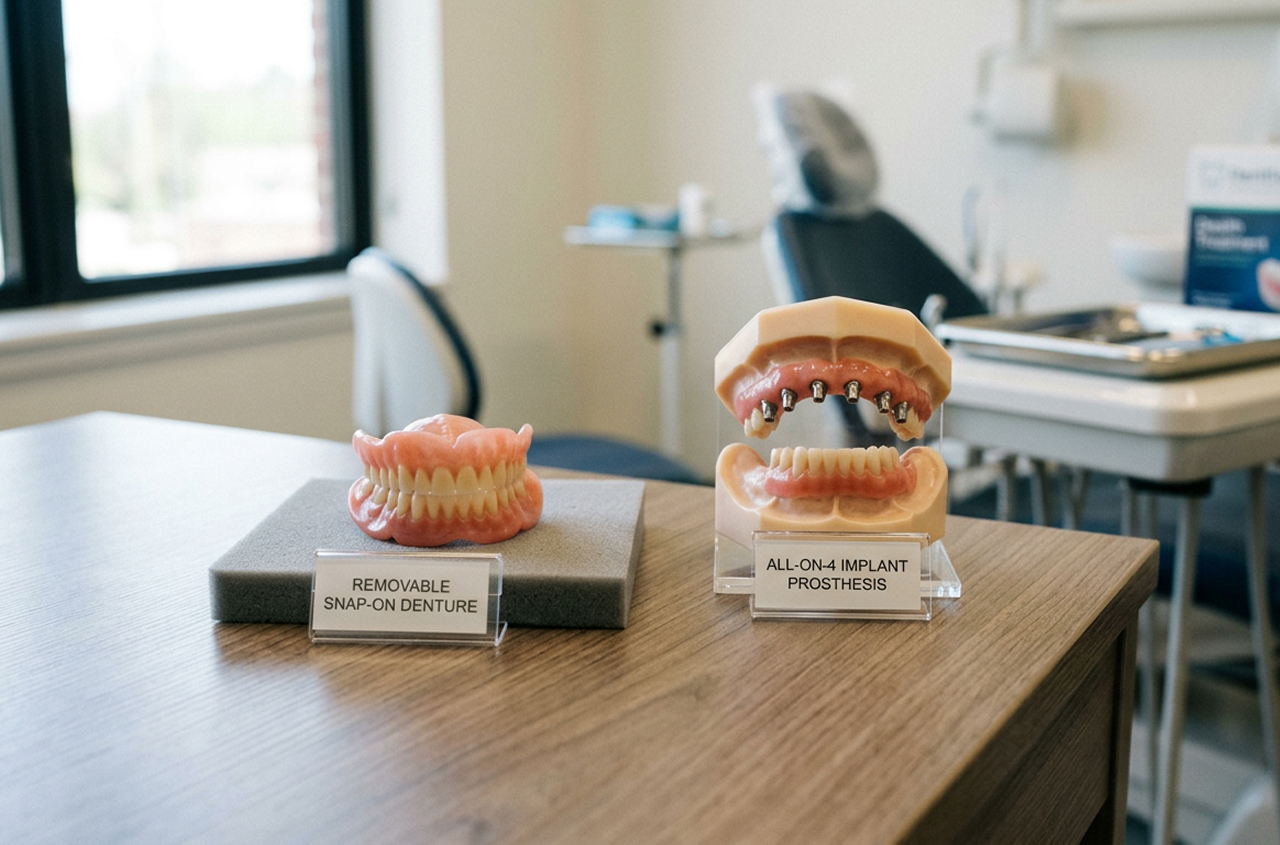
Most patients researching full-arch tooth replacement assume the choice comes down to price alone. In reality, the bigger difference between snap-on dentures and All-on-4 implants is how each one behaves during an ordinary Tuesday, eating lunch, laughing with friends, or waking up in the morning. That daily experience is often what determines which option a patient sticks with long term.
Both treatments replace a full arch of missing teeth using dental implants as the foundation. What separates them is how the replacement teeth attach to those implants, and that single detail changes almost everything about how the final result feels.
What Snap-On Dentures Actually Are
Snap-on dentures, sometimes called implant-retained overdentures, use a small number of implants, typically two to four, placed strategically in the jaw. A denture is then designed with attachments on its underside that snap onto those implants, holding it far more securely than a traditional denture ever could.
The denture can still be removed by the patient each night for cleaning, which is a detail many people find reassuring during the decision process. It rests closer to the gum line than a fixed prosthesis, which some patients prefer for the sensation of a more traditional denture with added stability.
What All-on-4 Implants Actually Are
All-on-4 uses four implants placed at specific angles to support a full arch of replacement teeth that stay fixed in the mouth. Unlike snap-on dentures, the patient does not remove this prosthesis at home. It functions much closer to natural teeth, both in how it feels and in how biting force is distributed across the jaw.
Because the implants are angled to make use of the denser bone typically found at the front of the jaw, many patients qualify for All-on-4 even after years of missing teeth or some bone loss, without necessarily needing a separate bone graft first. Longevity varies by patient, oral hygiene, and how well the bone integrates with the implants, so results should always be discussed individually rather than assumed.
Comfort and Daily Function
Patients who choose All-on-4 often describe the eating experience as closer to their natural teeth, since the prosthesis does not shift during chewing. Snap-on dentures are a significant improvement over traditional dentures in this respect, but because they are removable, there is still a small range of movement that some patients notice with harder or stickier foods.
Speech tends to adjust quickly with both options, though patients moving from loose traditional dentures usually notice the improvement in speech clarity almost immediately with either treatment.
Cost and Maintenance Differences
Snap-on dentures generally involve a lower upfront cost than All-on-4, largely because fewer implants are placed and the denture itself is a less complex piece of dental work. All-on-4 typically costs more initially but is designed to function as a long-term fixed solution rather than a removable appliance.
Maintenance looks different for each. Snap-on dentures need to be removed nightly, cleaned like a traditional denture, and the attachment components may need periodic replacement as they wear. All-on-4 is cleaned more like natural teeth, using specialized brushes and floss threaders around the fixed bridge, with regular checkups to monitor the implants and surrounding bone.
Who Tends to Prefer Each Option
Patients who value being able to remove their teeth at night, who are working with a tighter budget, or who have some bone loss that makes a full four-implant placement more complex sometimes lean toward snap-on dentures as a strong middle-ground solution.
Patients who want teeth that feel as close to permanent as possible, who eat a wide variety of foods without wanting to think about it, or who simply do not want a removable appliance tend to gravitate toward All-on-4.
How Bone Health Factors Into the Decision
What often gets left out of this comparison is that jawbone condition, not personal preference, sometimes makes the decision for the patient before cost or comfort even enter the conversation. Significant bone loss can limit which implant positions are viable, which is why an evaluation with imaging is typically the real starting point, not a brochure comparison.
Conclusion
Snap-on dentures and All-on-4 implants both solve the same underlying problem, missing teeth, but they solve it in different ways with different tradeoffs in comfort, cost, and daily care. The right choice depends on bone health, budget, and how a patient wants their daily routine to look. Dr. Christopher Rodas and Dr. Helena Wu work with High Desert Dental patients in Albuquerque to evaluate which option fits their specific jaw structure and lifestyle. To find out which solution makes sense for you, call (505) 888-2606 to schedule a consultation.